
Abstract
Somewhere in San Francisco, a software engineer is being paid $1.5 million a year to build the machine that is supposedly coming for his job. He is not panicking. He is not updating his resume. He just got a raise.
That should not make sense. Every headline insists AI is replacing engineers. Every layoff post on LinkedIn insists it too, black-and-white selfie and "grateful for the journey" caption included. And yet the company holding the match, the one that built the fire in the first place, is hiring aggressively and spending billions to keep its own firefighters from walking off the job.
This case study looks at what OpenAI's financials actually say about the replacement narrative: the cost of compute, the cost of talent, and the widening gap between revenue and the capital required to keep scaling. The evidence doesn't fully settle the debate no eighteen-month financial snapshot could but it does complicate the simple "AI replaces engineers" story considerably, and it points toward a more useful question: what is AI actually doing to the value and shape of engineering work, and what should companies do about the widening skills-and-cost gap in the meantime?
Introduction: The Replacement Narrative
The assumption baked into most AI-and-jobs commentary is that a machine which can write your code can also do your job. That assumption skips a step. Writing code was never the hardest or most valuable part of software engineering; it was the most mechanical part, the part most easily specified and checked. Coding assistants like GitHub Copilot and ChatGPT can now generate functions, explain logic, and catch bugs in seconds. That is real automation. It is not automatically the same thing as replacement.
Replacement is a much higher bar: falling headcount, shrinking R&D budgets, and a demonstrable, sustained decline in demand for the labor being "replaced." This study asks whether those conditions show up in the numbers at the company with the most to gain from proving they do, and takes seriously the ways the evidence doesn't fully answer the question either.
Source: Reuters figures cited in this study
Financial Anatomy of ChatGPT
Revenue Growth
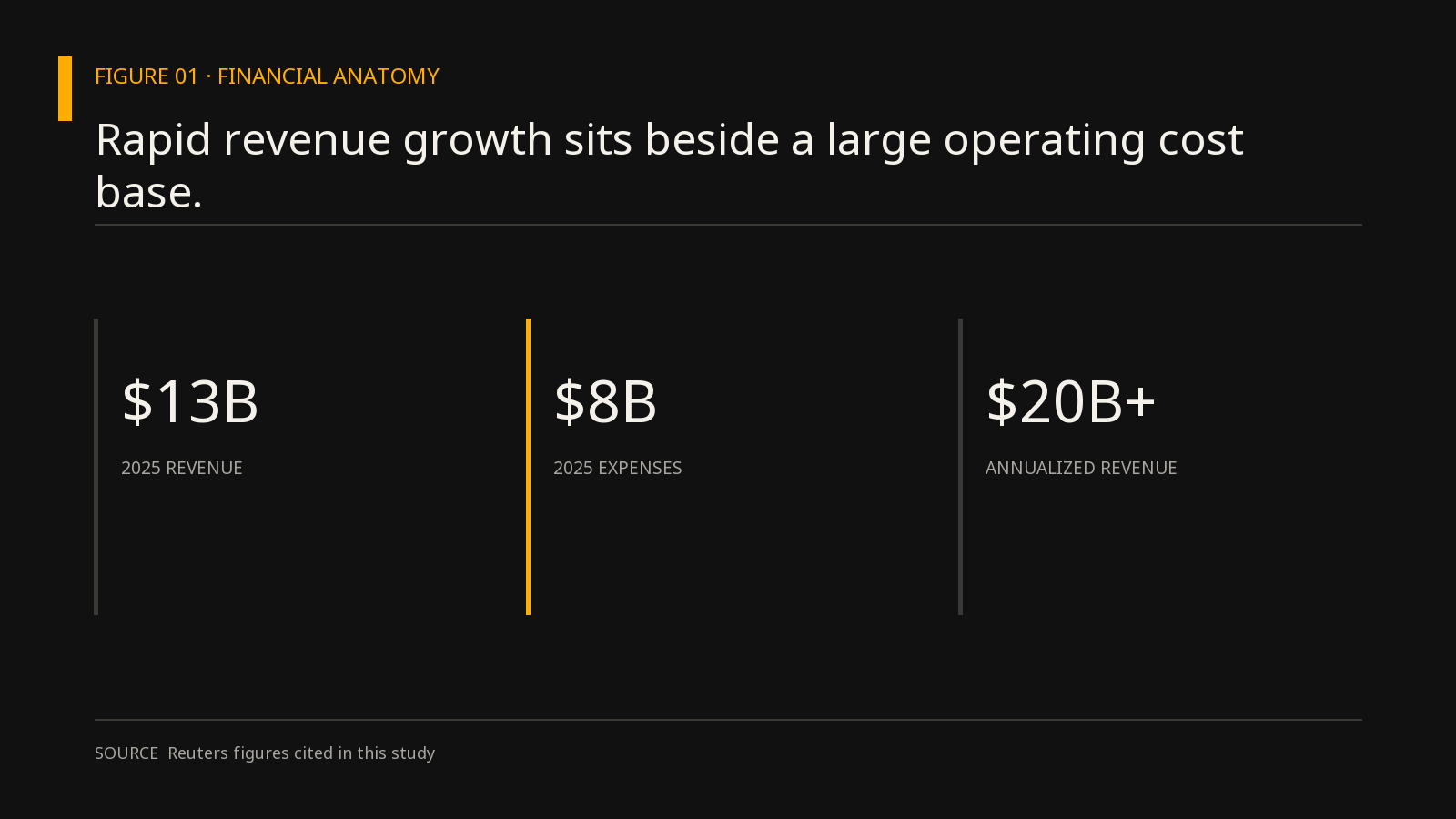
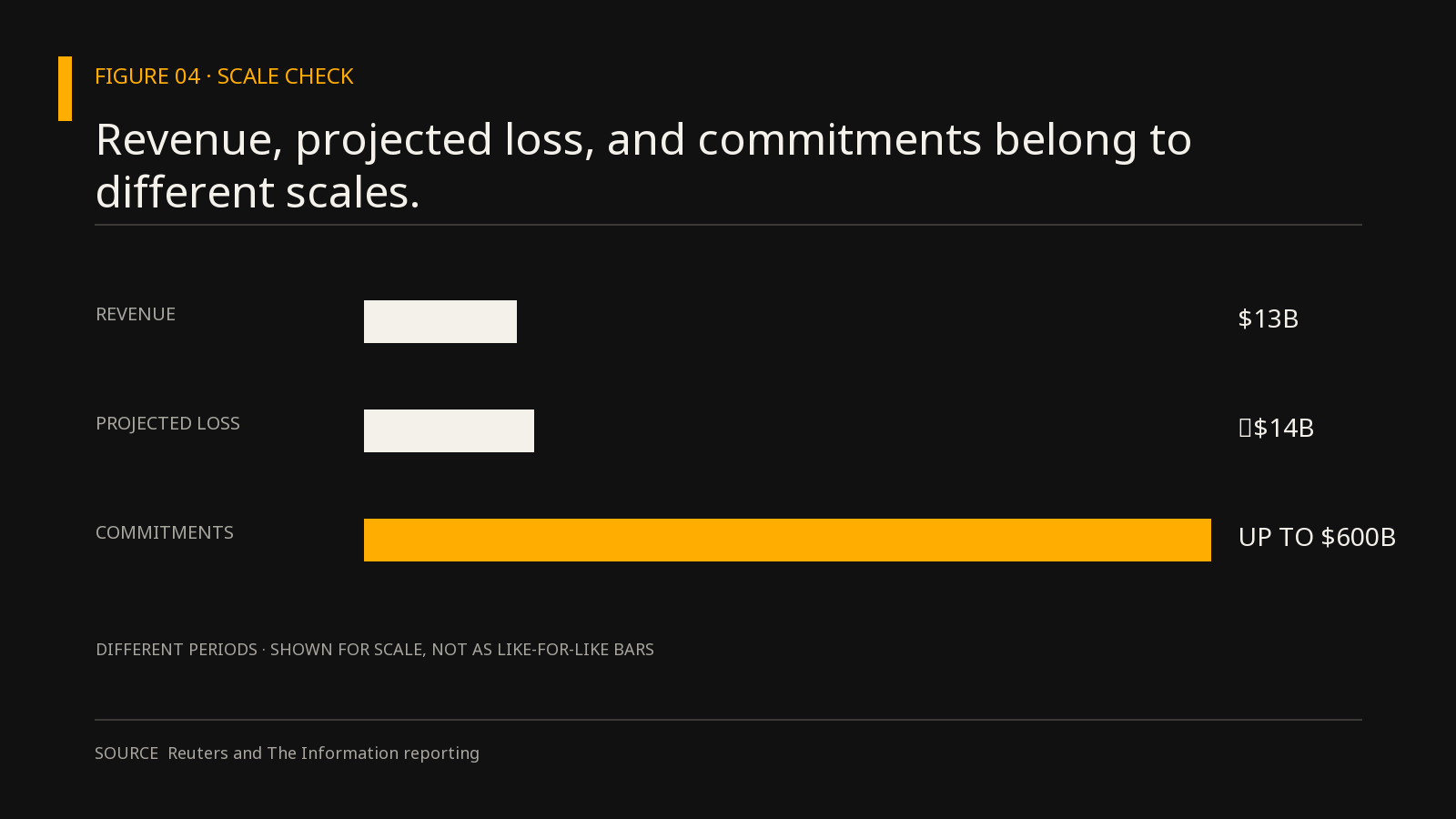
On paper, OpenAI looks like one of the fastest-scaling businesses in history. According to Reuters, the company generated roughly $13 billion in revenue in 2025 against about $8 billion in expenses, with annualized recurring revenue surpassing $20 billion, driven by consumer subscriptions and enterprise contracts.
But growth at this pace is largely a story of adoption, not operating leverage. The more revealing numbers sit in the cost structure underneath.
Cost Factor #1: Infrastructure and Electricity
Traditional software scales like a book: expensive to write once, nearly free to copy forever. AI runs a different ledger: every query is a fresh cost, with no discount for having answered a similar one yesterday.
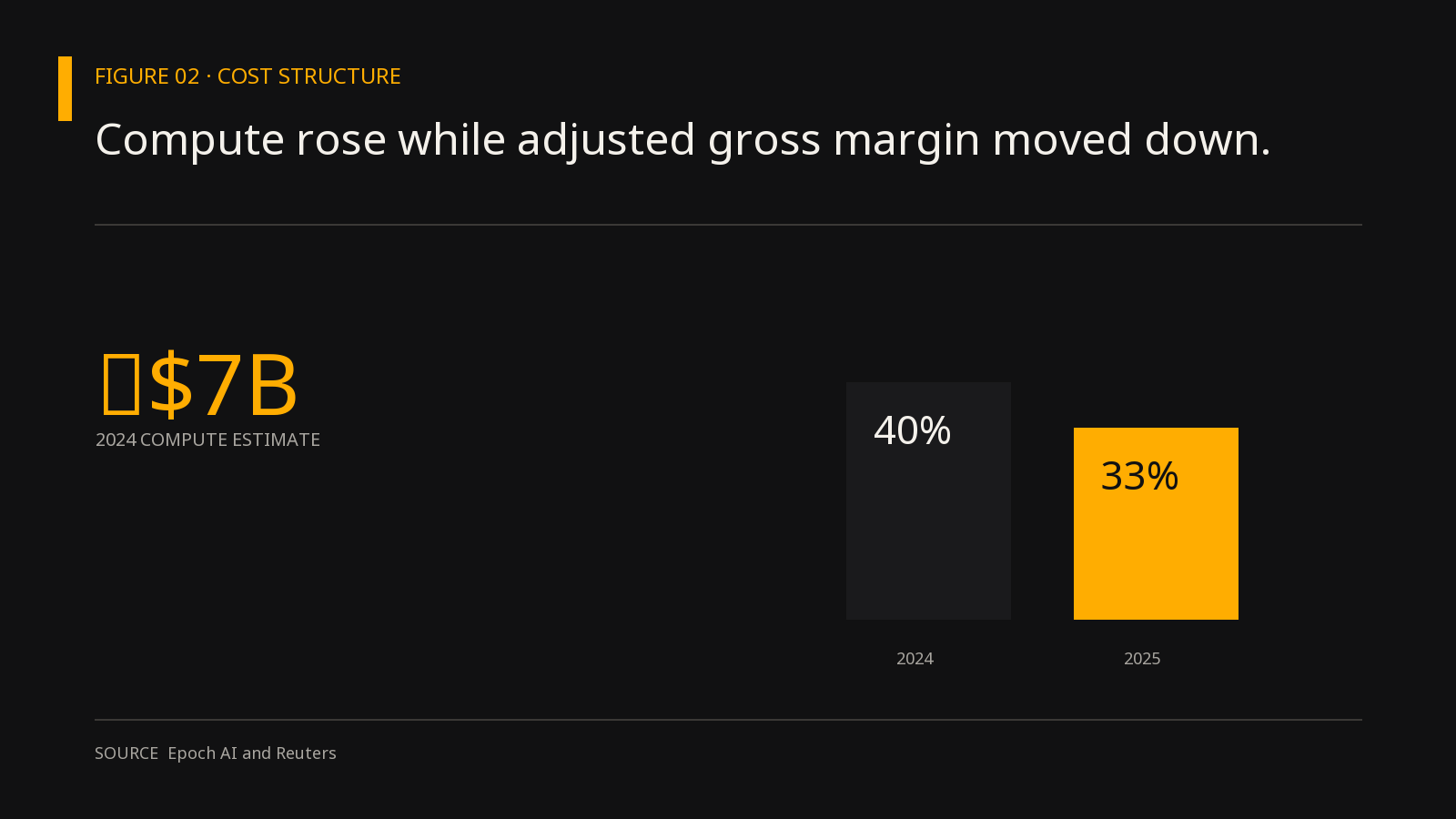
Epoch AI estimates OpenAI's 2024 compute spend at roughly $7 billion, about $5 billion for R&D (including training) and $2 billion for inference. Reporting citing The Information put the full-year 2024 compute closer to $5.6 billion. The estimates diverge somewhat, but they agree on the direction: compute is the largest and fastest-growing line on OpenAI's balance sheet, spanning GPU clusters, data centers, cooling, and raw power.
At the individual-query level, Epoch AI estimates a single GPT-4o response consumes about 0.3 watt-hours, trivial in isolation, but multiplied across billions of daily interactions with no caching or economy of repetition, it compounds relentlessly.
The consequence shows up directly in margins. Reuters reports OpenAI's adjusted gross margin fell from roughly 40% in 2024 to 33% in 2025, while inference costs alone quadrupled over the same period. That is the inverse of what investors expect from a scaling software business: costs accelerating alongside revenue rather than flattening out. It behaves less like a software platform and more like a utility one where serving more customers costs proportionally more, not less.
Source: Epoch AI and Reuters
Cost Factor #2: Human Engineers
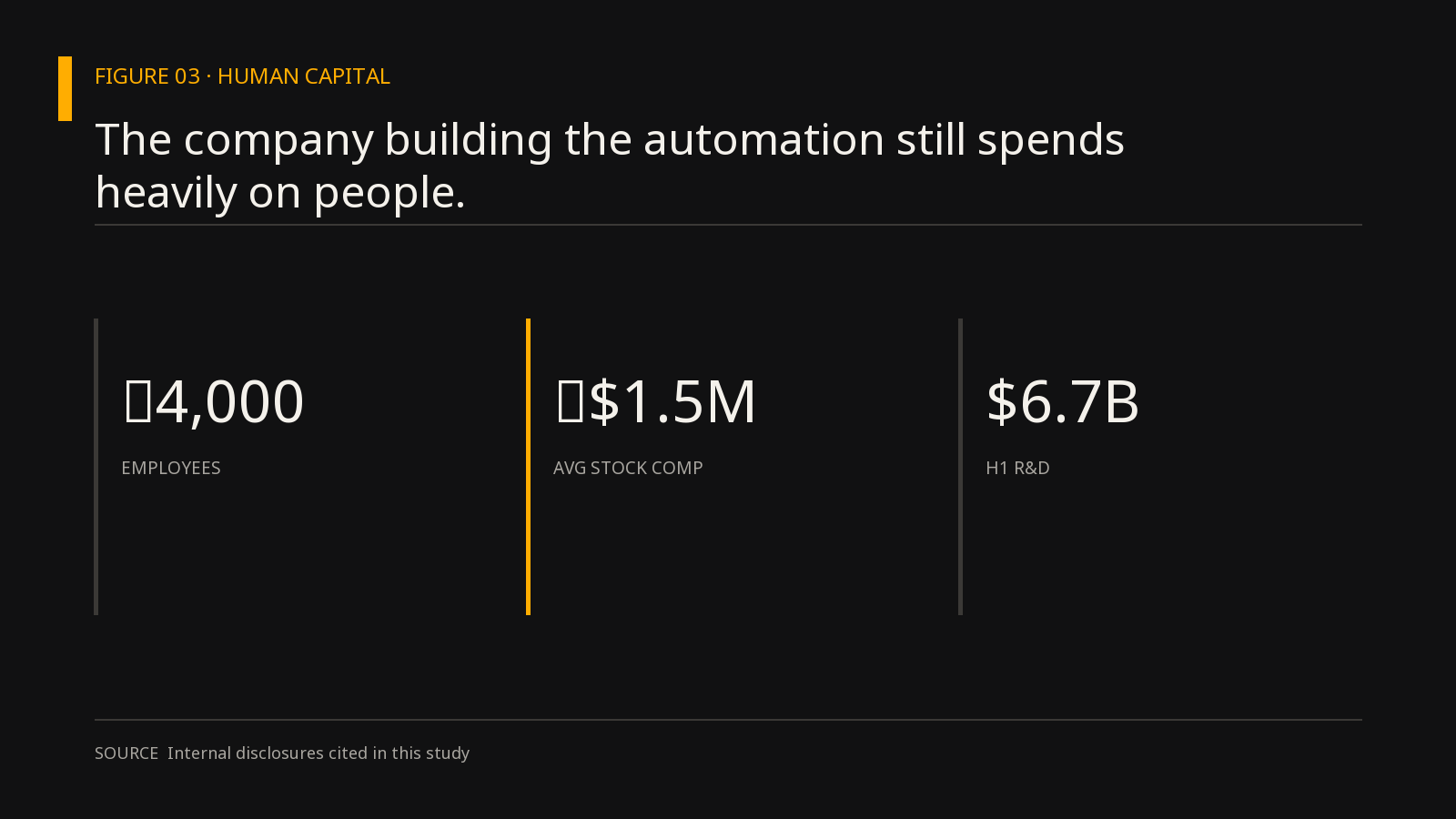
If AI were genuinely displacing engineering labor, it should show up first in headcount, R&D spend, and compensation. OpenAI's numbers currently point the other way. Internal financial disclosures put the company at about 4,000 employees in 2025, with average stock-based compensation near $1.5 million per employee. The same disclosures show roughly $6.7 billion in R&D spending in the first half of 2025 alone, alongside $2.5 billion in stock-based compensation over that period.
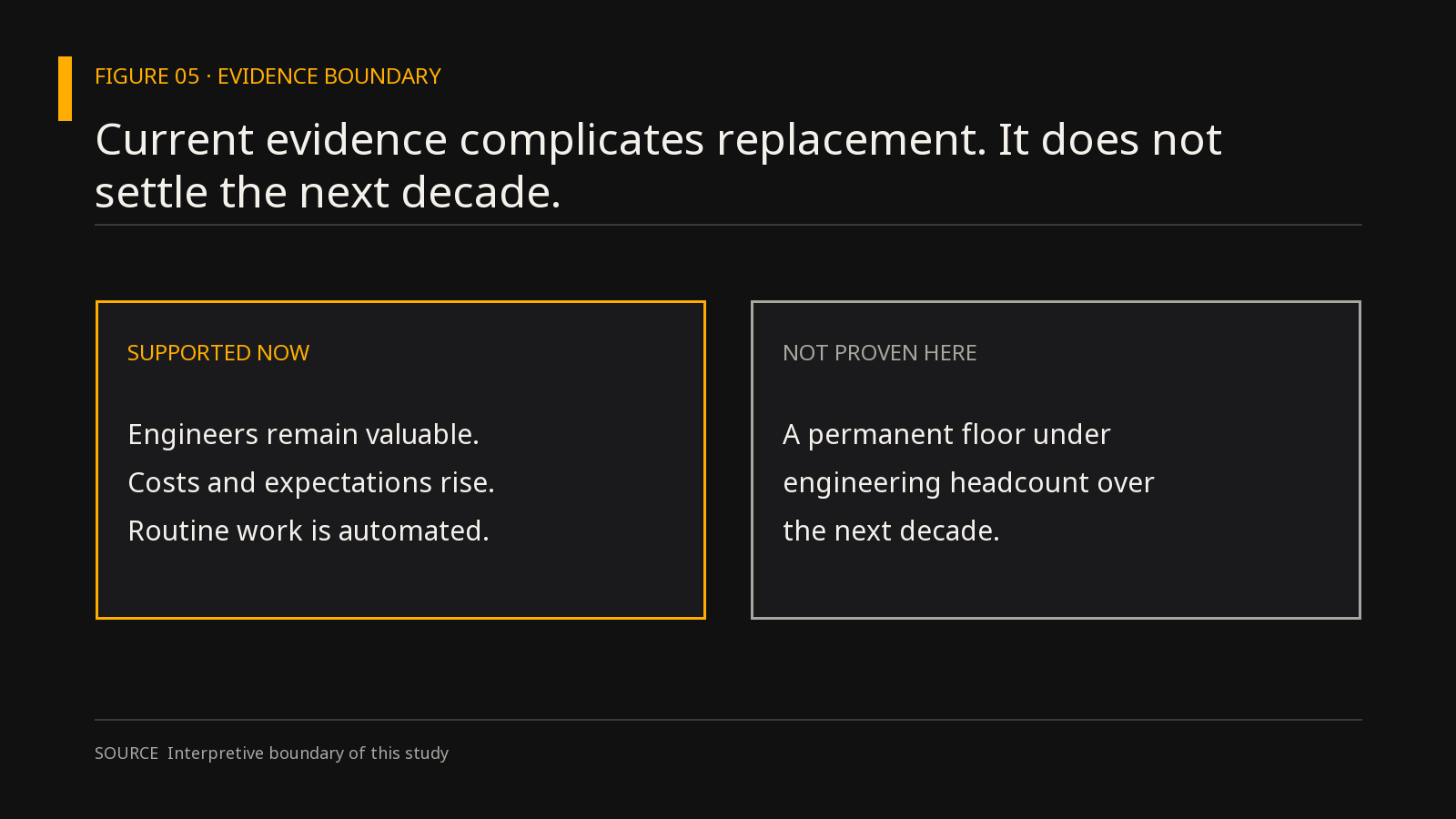
Two things can be true at once, though. This is consistent with engineers being structurally hard to replace, and it is also consistent with a company in the middle of an unprecedented talent war with Meta, Anthropic, Google, and a dozen well-funded labs, where pay is inflated by scarcity and competition as much as by irreplaceability. High comp in 2025 tells us engineers are valuable right now. It's weaker evidence about whether that will still be true in five years, once models mature and talent competition cools. The financial record supports "not replaced yet" more confidently than it supports "cannot be replaced."
Why the demand persists in the meantime: models require continuous fine-tuning, alignment work, safety testing, infrastructure optimization, and security auditing, none of which the models perform on themselves. Every hallucination that reaches a user, every security gap, every deployment failure is a human problem needing a human fix. So far, AI hasn't eliminated the need for engineers; it's raised the ceiling on what they are expected to manage while automating a real share of the routine work underneath.
Source: Internal disclosures cited in this study
The Paradox and Its Limits
Here is a useful test for any "AI will replace X" claim: find the organization with the most to gain from replacing X, and check whether it has done so. If it hasn't, despite having every incentive to be first, that is meaningful evidence, though not proof. It is possible OpenAI simply hasn't gotten there yet; an eighteen-month window during an infrastructure buildout is a short baseline from which to declare the question closed.
It's also worth being honest that OpenAI is not the whole industry. Other companies Salesforce, Klarna, and many startups among them have publicly tied engineering layoffs to AI-driven productivity gains over the same period. Their situations differ (smaller scale, more mature codebases, different investor pressure), but they complicate any claim that "the industry" has settled on non-replacement as the answer. The most defensible version of the argument isn't "AI won't replace engineers"; it's "the company with the strongest incentive and clearest technical view of AI's limits is, so far, behaving as though it can't replace them yet, and is spending accordingly."
The numbers support a shift in the shape of demand: less tolerance for routine, boilerplate work; sharply higher stakes and skill requirements for the engineers who remain. What they support less well is a permanent floor under total engineering headcount industry-wide; that's a claim about the next decade, and the evidence here covers about two years.
Source: Interpretive boundary of this study
Even the arsonist, it turns out, buys fire insurance. If lighting the match were really the same as putting out the fire, the company holding it wouldn't still be paying full-time firefighters seven-figure retainers.
Projected Losses and Long-Term Capital Intensity
The number that matters more than the $13 billion in 2025 revenue is what sits next to it. Reporting on internal OpenAI documents, first surfaced by The Information, projects a roughly $14 billion loss in 2026, alongside long-term compute commitments of up to $600 billion through 2030, a figure that rivals the infrastructure investment of entire national energy grids.
This is a separate claim from the labor question, and the two are often blurred together. The capital intensity of frontier AI says something about whether the business model is sustainable at this scale; it doesn't, by itself, say whether engineers are safe. A company can be capital-starved and still automate labor aggressively, or capital-rich and still need every engineer it has. What the $600 billion commitment does tell us clearly: this is now closer to a heavy-industry cost structure than a software one, and heavy industries generally do not shed the specialized engineers who keep the plant running; they compete hard to keep them.
Source: Reuters and The Information reporting
Why Full Replacement Is Still a Hard Sell
Technical
LLMs still hallucinate APIs that don't exist, reproduce known vulnerability patterns, and struggle to reason across large, interconnected system architectures. They lack durable long-term planning and the ability to hold a technical vision across months and adjust today's decisions for tomorrow's consequences. A machine that can write a thousand lines of code in a second still can't be trusted to leave itself alone in a room.
Organizational
Engineering work includes product judgment, compliance and legal risk assessment, and accountability when something breaks. When a system fails, a human answers for it. Models have no professional reputation at stake and cannot be put on a performance improvement plan.
Economic
Traditional software has near-zero marginal distribution cost once built. AI inference does not; training and serving costs rise with usage and require continuous retraining as the world changes. That cost structure looks like a utility's, not a software vendor's, and utilities don't typically eliminate the engineers who run the plant. They employ more of them, and then buy them dinner.
What This Means for Companies Right Now
None of this means the status quo holds. It means the shape of the problem has changed: engineering talent is getting more expensive and harder to retain at the frontier (OpenAI's $1.5M average comp is the extreme case, but the wage pressure it creates ripples outward), while the actual demand for skilled engineering, fine-tuning, integration, security, QA, infrastructure, and the "boring" work that keeps AI-adjacent systems reliable keeps climbing. For most companies outside the handful of frontier labs, the practical question isn't "will AI replace our engineers," it's "how do we get reliable engineering capacity without competing for talent against a company paying seven figures per head."
This is exactly the gap staff augmentation is built to close.
Riseup Asia LLC provides staff augmentation and dedicated engineering support, Python, AI/ML, full-stack, and QA talent, at a fraction of the cost structure driving compensation at frontier labs, without the overhead of a full in-house hiring cycle. For companies watching engineering costs climb in the AI talent war, that means:
- Flexible capacity: Scale a team up for a build phase or a migration and back down afterward, instead of carrying frontier-market salaries year-round for work that doesn't require frontier-lab pay.
- Cost-efficient delivery: Access experienced engineering and AI/ML talent at rates that reflect a lower-overhead base, without giving up quality or communication.
- Speed to start: Skip the multi-month hiring cycle and the competition for the same scarce talent pool everyone else is bidding on; augmented staff can be embedded into an existing team quickly.
- Coverage for the "unglamorous but essential" work this case study points to: integration, testing, security review, infrastructure maintenance, the exact category of engineering effort that AI raises the stakes on rather than eliminates.
You don't need to out-hire OpenAI's talent war to win the engineering problem it created. You need a partner who can put the right hands on the keyboard without the seven-figure price tag. That's the gap Riseup Asia is built to fill.
Conclusion
OpenAI isn't automating itself out of its own labor costs, at least not yet, and the evidence available today doesn't support that. It is spending billions to retain elite talent, committing to infrastructure investment that dwarfs most traditional technology businesses, and watching margins compress as it scales. The honest version of the conclusion isn't "AI will never replace engineers"; it's that the company with the clearest incentive and the closest technical view of AI's limits is, right now, behaving as though it can't, and pricing its bets accordingly.
The steam engine didn't eliminate labor; it moved it toward the people who could build, run, and improve steam engines. The internet didn't eliminate publishers or developers; it created new categories of them. AI is following a similar pattern so far, automating the routine while raising the price and the stakes of the judgment that's left.
The arsonist is still hiring firefighters. Until that changes, the smarter move for the rest of the industry isn't to panic about the fire; it's to make sure you can afford your own crew. That's the practical answer for companies trying to compete without a frontier lab's balance sheet: find engineering capacity that scales with the work instead of the hype cycle, which is precisely where staff augmentation partners like Riseup Asia come in.
References
- 1.Reuters (2026). OpenAI sees compute spend around $600 billion by 2030.
- 2.Epoch AI (2025). Most of OpenAI's 2024 compute went to experiments.
- 3.Epoch AI (2025). How much energy does ChatGPT use?
- 4.TechCrunch (2025). Leaked documents shed light on how much OpenAI pays Microsoft.
- 5.Fortune (2026). OpenAI is paying workers $1.5 million in stock-based compensation.
- 6.The Information, as reported by RD World Online (2026). Facing $14B losses in 2026, OpenAI seeks funding.